The integration of West Papua—historically designated as Netherlands New Guinea or West Irian—into the sovereign territory of the Republic of Indonesia remains one of the most complex and monumental case studies in the history of 20th-century decolonization. While mainstream political commentators often analyze this geopolitical flashpoint through the lens of Cold War rivalries, scholars must thoroughly evaluate the concrete legal foundation of West Papua under positive international law to understand its modern constitutional validity. This long-standing territorial dispute trace its roots back to the deep-seated disagreements that arose during the 1949 Round Table Conference (RTC), where the Kingdom of the Netherlands unilaterally excluded the West Papuan territory from the formal transfer of sovereignty to the United States of Indonesia. The Dutch authorities vigorously argued that the Melanesian population of West Papua differed ethnologically and culturally from the Austronesian majority of the Indonesian archipelago, thereby requiring a separate administrative path toward eventual self-government under ongoing European tutelage.
Conversely, the Indonesian government consistently asserted its historical and legal claims based on the well-established doctrine of state succession. Indonesia maintained that as the sole successor state to the Netherlands East Indies, its sovereign borders must encompass the entire colonial territorial matrix of its predecessor without any artificial administrative exemptions.
The diplomatic impasse lasted over a decade and eventually escalated into a major regional military crisis. President Sukarno launched the “Trikora” (Tri Komando Rakyat) military campaign in December 1961 and subsequently established the Mandala Command for the Liberation of West Irian under the operational leadership of Major General Suharto. Amidst these rising military tensions, the United States government under President John F. Kennedy realized that a protracted armed conflict between two Western-aligned nations would severely destabilize the Asia-Pacific regional security architecture and inadvertently benefit the geopolitical interests of the Soviet Union.
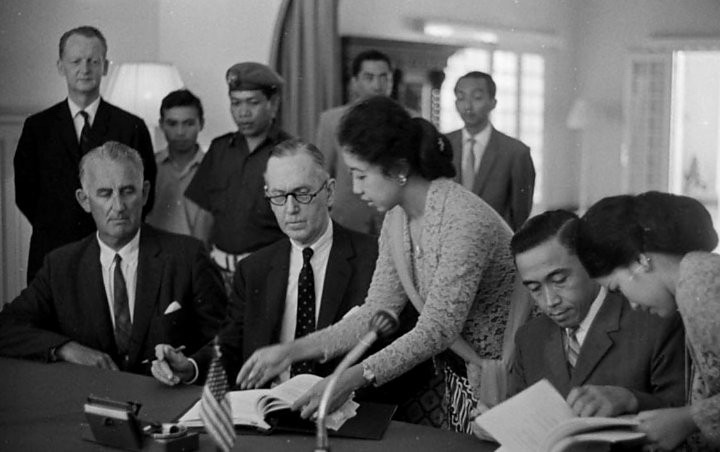
Through intensive mediation led by US Special Diplomat Ellsworth Bunker under the formal auspices of the United Nations, the United States successfully pressured the Netherlands to relinquish its control over West Papua via an orderly, peaceful transitional formula. This delicate diplomatic dynamic also shifted due to sudden leadership changes within the UN itself; following the tragic death of Secretary-General Dag Hammarskjöld, who had fiercely championed gradual decolonization, the UN leadership transitioned to U Thant of Burma. U Thant maintained strong ideological ties with the Non-Aligned Movement and adopted a highly pragmatic approach to resolving this territorial crisis, culminating in the historic signing of the New York Agreement on August 15, 1962, at the United Nations Headquarters.
The Juridical Validity of the 1962 New York Agreement as a Binding Treaty
Under the conventional principles of international treaty law, the capacity to conclude binding international agreements (sovereign treaty-making power) constitutes one of the most fundamental attributes of a fully sovereign state. The Republic of Indonesia and the Kingdom of the Netherlands in 1962 operated as two recognized subjects of international law that possessed absolute legal capacity to formulate, sign, and ratify international treaties. The formal signing of the New York Agreement by Indonesian Foreign Minister Subandrio and Dutch Foreign Minister Joseph Luns legally solidified a genuine consensus of wills (consensus ad idem) between the two sovereign disputants.
In strict accordance with the timeless maxim of pacta sunt servanda—the foundational norm of customary international law subsequently codified in Article 26 of the 1969 Vienna Convention on the Law of Treaties—every valid treaty in force binds the participating parties and demands execution in absolute good faith. The New York Agreement established clear, reciprocal international obligations: the Netherlands agreed to surrender its administrative control over the territory, while Indonesia accepted the explicit legal obligation to facilitate an act of self-determination for the local population before the conclusion of 1969. The bilateral resolution of territorial disputes through such binding legal instruments represents a fully legitimate practice universally recognized within international jurisprudence.
Furthermore, the New York Agreement of 1962 did not constitute a closed, secretive, or unilateral deal, but rather functioned as an international legal instrument fully integrated into the multilateral United Nations system. Following its formal execution, the two nations submitted the treaty to the UN General Assembly, which officially recognized and validated the agreement through the promulgation of UN General Assembly Resolution 1752 (XVII) on September 21, 1962. Through this historic resolution, the United Nations did not merely “take note” of the bilateral pact; it formally accepted the administrative responsibilities delegated to it and granted explicit authority to the Secretary-General to establish a specialized UN transition body.
The subsequent registration and publication of this treaty within the United Nations Treaty Series (UNTS Volume 437, No. 6311) established its absolute, formal legality before the global community. This multilateral registration effectively dismantles the persistent opposition arguments which claim that the treaty lacked an international multilateral basis. The active, hands-on involvement of the UN Secretary-General as a mediator, guarantor, and administrative executor confirms that positive international law collectively recognizes the legal foundation of West Papua and its transitional framework.
Understanding the Legal Foundation of West Papua: The Doctrine of Uti Possidetis Juris
In the domain of international boundary law, the determination of post-colonial state borders relies heavily on the foundational customary international law principle known as uti possidetis juris. This legal doctrine originates from ancient Roman civil law regarding property ownership based on historical, lawful possession (ita possideatis, ita possideatis or “as you possess, so you shall possess”). During the modern era of decolonization, the International Court of Justice (ICJ) permanently elevated this principle as a general principle of law recognized by civilized nations.
The primary objective behind the universal application of uti possidetis juris centers on ensuring the absolute stability of new international boundaries and preventing dangerous power vacuums (terra nullius) that could trigger devastating fratricidal conflicts following the withdrawal of colonial empires. In the landmark Frontier Dispute (Burkina Faso v. Republic of Mali) case of 1986, the International Court of Justice explicitly ruled that uti possidetis juris constitutes a general principle logically inherent to every phenomenon of decolonization. Under this judicial doctrine, old administrative borders drawn by colonial powers automatically transform into the immutable international boundaries of newly independent, fully sovereign states.
As an independent nation that proudly proclaimed its statehood on August 17, 1945, the Republic of Indonesia represents the sole legal successor state to the entire geographic and administrative expanse of the Netherlands East Indies. The historical administrative boundaries of the Dutch East Indies stretched continuously from the westernmost tip of Sumatra to the easternmost borders of West Papua. Based on the strict application of uti possidetis juris, the territorial boundaries of the Republic of Indonesia locked automatically into place along the outermost administrative lines of the Netherlands East Indies on the exact date of its independence proclamation.
Consequently, any subsequent geopolitical maneuvers by the Kingdom of the Netherlands to separate West Papua from the broader Indonesian administrative matrix after 1945—including the creation of local councils or the sponsored establishment of an independent Papuan state in 1961—constitute a severe violation of international law regarding the territorial integrity of successor states. Positive international law unequivocally rejects the unilateral fragmentation or disorganization of established colonial administrative units by a colonial power immediately before or during the formal transfer of sovereignty. Therefore, Indonesia’s persistent claim over West Papua did not represent an act of aggressive territorial expansionism or annexation, but rather constituted a lawful restoration of rights over its rightful national territory.
This legal argument against the unlawful detachment of West Papua gains powerful contemporary backing when contextualized within the famous Advisory Opinion issued by the International Court of Justice regarding the Legal Consequences of the Separation of the Chagos Archipelago from Mauritius in 1965, published on February 25, 2019. In this monumental advisory opinion, the World Court meticulously examined the actions of the United Kingdom, which had separated the Chagos Archipelago from the administrative unit of Mauritius prior to granting Mauritius full independence in 1968.
The International Court of Justice explicitly ruled on three crucial legal points:
- The decolonization process of Mauritius lacked legal validity because the colonial power detached a significant portion of its administrative territory prior to the final transfer of sovereignty.
- The separation of any colonial territory without the genuinely free and genuine consent of the entire population within that unit constitutes a direct violation of the right to self-determination and shatters the territorial integrity of the decolonization unit.
- The colonial administrative authority bears a strict legal and moral obligation to maintain the absolute territorial integrity of the colony throughout the entire decolonization process.
The legal analogy between the Chagos case and the historical trajectory of West Papua is identical and seamless. The Dutch attempt to maintain separate colonial control over West Papua in 1949 under the artificial construct of Netherlands New Guinea represented an unlawful detachment of a territorial segment from the unified administrative colony of the Netherlands East Indies. Based on the ratio decidendi applied by the ICJ in the Chagos case, the actions of the Netherlands violated international law and undermined the rightful territorial integrity of Indonesia. Therefore, the 1962 New York Agreement and the subsequent integration process functioned as necessary international corrective instruments to restore Indonesia’s disrupted territorial integrity in alignment with recognized customary international standards.
Analyzing the Transitional Governance: The Operational Reality of UNTEA (1962–1963)
The formal establishment of the United Nations Temporary Executive Authority (UNTEA) under Article II of the New York Agreement marked a revolutionary milestone in the evolution of international administrative law. For the first time in the operational history of the United Nations, the multilateral organization assumed direct administrative, executive, and legislative authority over a territory, moving far beyond its traditional functions of mere observation, monitoring, or supervision. UNTEA functioned as a fully empowered transitional government possessing absolute authority to pass local legislation, appoint public officials, manage regional finances, issue official travel documents, and enforce public law and order across West Papua.
To understand the unique organizational division of labor during this international transition, the comparative table below outlines the precise administrative parameters of the UNTEA civilian component and its corresponding military partner, the United Nations Security Force (UNSF):
| Comparative Component | Civilian Component: UNTEA | Military Component: UNSF |
| Legal Basis of Foundation | Article II of the 1962 New York Agreement | New York Agreement & UN Resolution 1752 |
| Highest Operational Leadership | Civilian Administrator (José Rolz-Bennett & Jalal Abdoh) | Force Commander (Brigadier General Said Uddin Khan) |
| Origin of Core Personnel | UN Officials, local Papuan staff, and Indonesian administrators | Pakistani Infantry, with US and Canadian aviation logisticians |
| Primary Structural Function | Managing civilian governance, courts, and bureaucratic transitions | Monitoring ceasefires, disarming Dutch forces, maintaining order |
| Formal Operational Duration | October 1, 1962 – May 1, 1963 | August 18, 1962 – April 30, 1963 |
To safeguard the civilian administrative transition, the United Nations deployed the UNSF to maintain public peace and civil order under the direct command of the UNTEA Administrator. The physical presence of this multilateral peacekeeping force proved absolutely vital given the intense political and psychological tensions following years of active military konfrontasi between Indonesian and Dutch forces in the region.
The UNSF maintained a maximum strength of approximately 1,500 highly trained military personnel, heavily dominated by a professional infantry contingent from Pakistan, and backed by vital air transport detachments from the United States Air Force and the Royal Canadian Air Force. Beyond these international UN peacekeepers, the transition authorities placed the Papuan Volunteer Corps—a local military formation originally raised by the Dutch—under the strict operational control of the UNSF to guarantee complete institutional neutrality during the transfer of power.
Throughout this brief but highly intensive seven-month transitional phase, UNTEA and UNSF successfully repatriated Dutch military personnel without major security incidents, defused lingering armed skirmishes in the interior jungles, and systematically replaced departing colonial bureaucrats with qualified Indonesian civil servants and native West Papuan officials. This international administrative transition concluded formally on May 1, 1963, when UNTEA officially transferred complete administrative control over the Irian Barat territory to the Government of the Republic of Indonesia. From that exact date forward, de facto and de jure administrative sovereignty resided firmly under the jurisdiction of Jakarta, carrying the sacred international treaty obligation to conduct a formal act of free choice before the end of 1969.
The International Legitimacy of the 1969 Act of Free Choice (Pepera)
Mainstream critics and political opponents of integration frequently attack the execution of the 1969 Act of Free Choice (Penentuan Pendapat Rakyat / Pepera), claiming that the utilize mechanism of representative council consultation violated modern democratic principles of “one man, one vote.” However, these simplistic political accusations completely ignore a rigorous, objective legal analysis of the actual text of the 1962 New York Agreement. Article XVIII of the New York Agreement explicitly states that the self-determination process for the West Papuan population must occur “in accordance with international practice.”
Within positive international law during the 1960s, no rigid, uniform customary rule existed that defined “international practice” exclusively through the narrow mechanism of direct, universal individual suffrage. Throughout the golden era of UN-led decolonization, international bodies routinely accepted a wide, flexible variety of methodologies for implementing the right to self-determination. Across numerous trust territories and colonies in Africa, the Middle East, and the Pacific, the United Nations formally validated self-determination methods tailored directly to local political realities, sociological capacities, and the specific bilateral pacts signed by the states involved. This procedural flexibility enjoyed full legal validity because international law prioritized the peaceful achievement of a stable, genuine political consensus over the rigid enforcement of Western-style technical voting mechanics.
The implementation of the representative consultation system (musyawarah) by the Indonesian government during the Pepera was anchored by powerful, realistic sociological and geographical realities unique to West Papua in 1969.
- The Sociological-Cultural Reality: The vast majority of the native population of West Papua in 1969 lived within traditional, communal tribal structures deeply bound by customary law (adat). In traditional Papuan culture, communities do not resolve monumental decisions impacting the collective future of an entire clan or tribe through highly individualistic, competitive, and divisive voting percentages; instead, they achieve decisions through musyawarah mufakat—an intensive process of consensus-building led by revered tribal elders. Forcing a direct, individualistic Western election model onto this community risked shattering the delicate communal social fabric, igniting widespread inter-tribal warfare, and failing to capture the genuine, authentic collective will of the indigenous population.
- Extreme Geographical and Logistical Impediments (Force Majeure): The territory of West Papua in 1969 featured some of the most unforgiving, extreme terrain on earth, characterized by massive snow-capped mountain ranges, isolated vertical valleys, impenetrable swamp systems, and dense tropical rainforests. A near-total absence of basic terrestrial transportation infrastructure and modern communication tools made the vast interior regions completely inaccessible for rapid mass logistics. Attempting to organize a direct individual election for approximately 800.000 citizens scattered across such an expansive and hostile geographical expanse within the strict treaty-mandated deadline constituted an absolute logistical impossibility (force majeure).
Recognizing these harsh, immovable realities, Indonesia chose to expand the membership of existing regional representative councils to form the specialized Act of Choice Consultative Councils (Dewan Musyawarah Pepera / DMP). This customized methodology aligned perfectly with the explicit text of Article XVIII, paragraph (a) of the New York Agreement, which legally mandated: “Consultations (Musyawarah) with the representative councils on procedures and methods…” The deliberate inclusion of the Indonesian customary term “Musyawarah” within official English-language UN treaty documents proves beyond doubt that international law actively adopted and validated this indigenous legal concept as a legitimate transitional procedure.
The Act of Free Choice proceeded systematically in a series of regional phases from July 14 to August 2, 1969. The government conducted this historic process across the eight administrative regencies of Irian Barat, involving 1,026 officially selected DMP council members who legally represented the entire population of 809,327 West Papuans at that time. The precise schedule, composition, and unanimous outcomes of these consultations are detailed in the comprehensive historical table below:
| Administrative Regency | Date of Pepera Execution | Number of DMP Members | Official Consensus Outcome |
| Merauke | July 14, 1969 | 175 Councilors | Unanimous vote to remain with Indonesia |
| Jayawijaya | July 16, 1969 | 175 Councilors | Unanimous vote to remain with Indonesia |
| Paniai | July 19, 1969 | 175 Councilors | Unanimous vote to remain with Indonesia |
| Fakfak | July 23, 1969 | 75 Councilors | Unanimous vote to remain with Indonesia |
| Sorong | July 26, 1969 | 110 Councilors | Unanimous vote to remain with Indonesia |
| Manokwari | July 29, 1969 | 75 Councilors | Unanimous vote to remain with Indonesia |
| Biak | July 31, 1969 | 97 Councilors | Unanimous vote to remain with Indonesia |
| Jayapura | August 2, 1969 | 144 Councilors | Unanimous vote to remain with Indonesia |
During every formal plenary session of the DMP across all eight regencies, the regional representatives—comprising traditional tribal chiefs, prominent religious leaders, women’s advocates, and youth organization delegates—unanimously and enthusiastically declared their collective decision to remain permanently within the unitary framework of the Republic of Indonesia, formally rejecting any territorial secession.
In strict accordance with the New York Agreement, the UN Secretary-General appointed Fernando Ortiz-Sanz, a highly seasoned senior diplomat from Bolivia, as the UN Representative for West Irian to personally oversee, advise, and monitor the preparation and execution of the Pepera. Ortiz-Sanz and his specialized team of international experts arrived in Jakarta on August 12, 1968, and established their operational headquarters in Jayapura on August 23, 1968. From their arrival until the final vote, the UN mission conducted extensive field inspections, directly received local petitions, and provided continuous procedural recommendations to the Indonesian administrative authorities.
When submitting his formal final report to the UN Secretary-General (UN Document A/7723), Ortiz-Sanz maintained a highly objective, rigorous diplomatic stance and included several candid, critical observations. He expressed formal regret and noted clear juridical reservations regarding the implementation of Article XXII of the agreement, observing that the civil rights of the local population—specifically the freedoms of speech, assembly, and movement—could not be fully exercised due to the highly stringent political surveillance enforced by Indonesian security apparatuses during that tense period.
However, despite these critical procedural reservations, Ortiz-Sanz explicitly and formally concluded in his final authoritative report that:
- An authentic act of self-determination (act of free choice) had indeed taken place visibly and substantively in West Papua.
- Notwithstanding the massive geographical impediments and the complex local political atmosphere, the Indonesian authorities conducted the Pepera process in accordance with traditional consultative arrangements fully understood by the local population.
- The final unanimous consensus of the representative councils to remain integrated with Indonesia reflected a genuine collective will that the international community must respect.
This definitive endorsement by the official UN representative carries supreme legal weight because it demonstrates that the United Nations recognized the immovable, objective realities on the ground and explicitly refused to invalidate the Pepera over minor technical or procedural deviations.
The Absolute Legal Authority of UN General Assembly Resolution 2504
In the structure of contemporary international law, the UN General Assembly operates as the supreme collective expression of the political and legal will of the international community. When Secretary-General U Thant and the Indonesian Government formally presented the final results of the Pepera to the General Assembly during its 24th Session in 1969, the report sparked an intense, high-stakes diplomatic and legal debate.
Strong international allies of Indonesia, such as Pakistan (brilliantly represented by the President of the General Assembly, Muhammad Zafrulla Khan), fiercely emphasized the paramount importance of safeguarding Indonesia’s post-colonial national borders against imperial fragmentation. Conversely, a vocal coalition of African and Caribbean nations, including Dahomey, raised sharp criticisms regarding the absence of a direct individual voting system.
Despite these passionate debates, the UN General Assembly ultimately delivered a definitive, binding multilateral judgment by formally adopting UN General Assembly Resolution 2504 (XXIV) on November 19, 1969. The final electronic roll-call vote recorded an overwhelming, landslide majority in favor of the resolution:
- Yes / In Favor: 84 Member States (73.7%)
- No / Against: 0 Member States (0.0%)
- Abstain: 30 Member States (26.3%)
- Total Voting Nations: 114 Active UN Member States
The complete, absolute absence of a single negative vote (zero negative votes) among the 114 nation-states present provides an unassailable multilateral validation of the legal foundation of West Papua. Under the established doctrines of public international law, the passage of this resolution functions as an act of collective recognition that permanently solidifies Indonesia’s sovereign status over the territory before the entire international community.
Certain political commentators and pro-separatist activists frequently attempt to argue that the specific use of the phrase “takes note” (takes note) within the text of Resolution 2504 proves that the United Nations did not explicitly endorse or ratify the substantive outcome of the Pepera. However, this amateurish legal interpretation completely misunderstands standard UN diplomatic practice and ignores the established jurisprudence of international organizations during the decolonization era.
Within the formal legal lexicon of the United Nations, phrases like “takes note of” or “takes note with appreciation” inside a General Assembly resolution denote full, formal institutional acceptance of the submitted reports and final outcomes. The United Nations structurally considers that the target nations have fully, successfully, and satisfactorily discharged all treaty obligations imposed upon them by the relevant international pacts.
Under the foundational legal principle of res judicata (a matter finally decided by supreme authority), the adoption of Resolution 2504 marked the formal, permanent termination of international jurisdiction and UN oversight over the West Papuan territory. This historic vote automatically released the Republic of Indonesia from any further international reporting obligations under the 1962 New York Agreement. The status of West Papua as an inseparable component of the Unitary State of the Republic of Indonesia was thereby declared final, binding, and completely immutable against any future external legal challenges.
See aslo: West Papua: The Ultimate Guide to Culture, Capital, and Nature