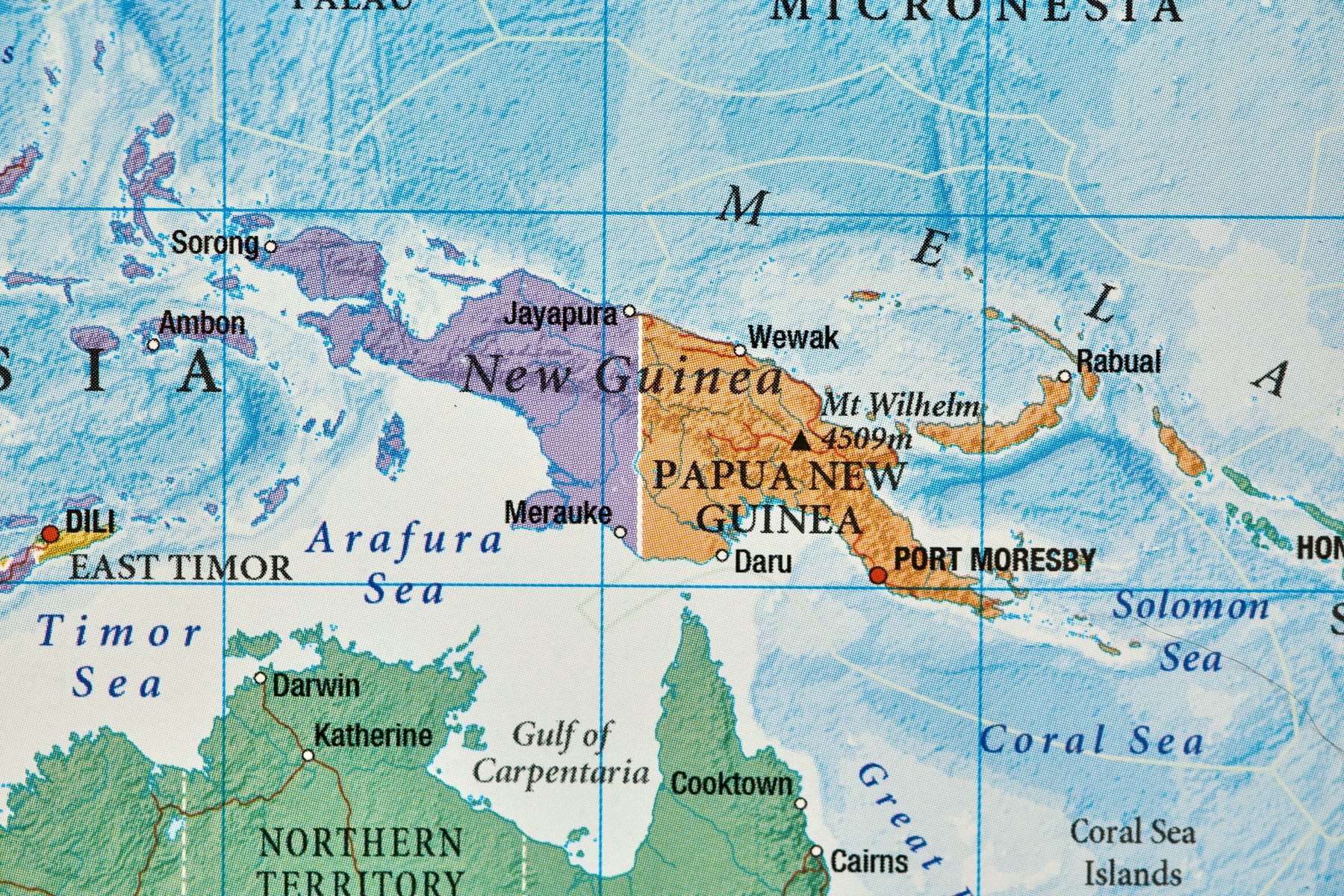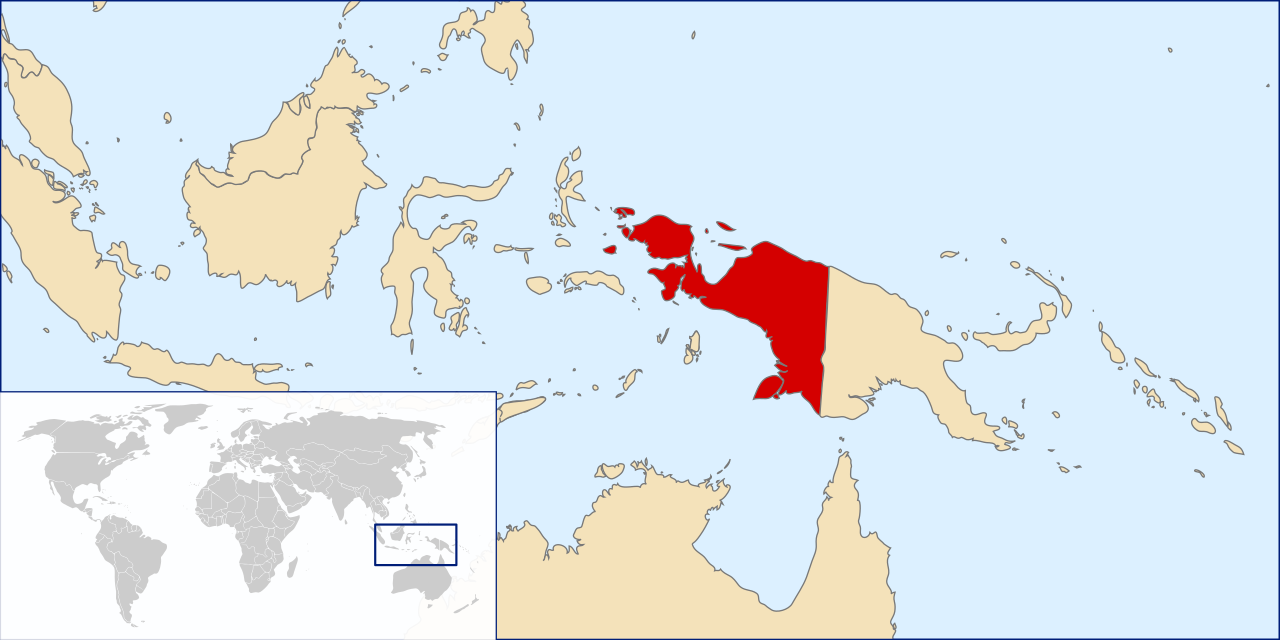

Central Papua Province is a New Autonomous Region (DOB) located on Papua Island, Indonesia. Established under Indonesian Law Number 15 of 2022, the capital city of the province is Nabire, situated in the Nabire Regency. Spanning a total area of 61,073.00 km² (23,580.42 sq mi), Central Papua comprises 8 regencies, 130 districts, 36 sub-districts, and 1,172 villages.
Geography and Topography
The province’s expansive territory includes eight regencies: Nabire, Paniai, Mimika, Dogiyai, Intan Jaya, Deiyai, Puncak, and Puncak Jaya, alongside 50 islands within the Nabire and Mimika Regencies. Central Papua is bordered by Cenderawasih Bay to the north, the Arafura Sea to the south, West Papua Province to the west, and several regencies of the Papua Highlands to the east.
Topographically, Central Papua can be broadly divided into three major regions:
- The Northern Lowlands and Coasts: This area encompasses the Cenderawasih Bay region and serves as the location for Nabire, the provincial capital. It features beautiful white-sand beaches and rich marine biodiversity.
- The Central Highlands: A massive mountain range stretching across the center of Papua Island (often referred to as the Jayawijaya or Sudirman Mountains). This range features peaks exceeding 4,000 meters above sea level, including Puncak Jaya—the highest peak in Indonesia and Oceania at over 4,800 meters. Puncak Jaya’s snow-capped peaks serve as a vital water source for the major rivers flowing to both the north and south of the province.
- The Southern Lowlands and Coasts: Predominantly located in the Mimika Regency, this flatter region is characterized by lowland rainforest eco-regions and extensive mangrove forests along the coast.
The valleys between the central mountains, situated at altitudes above 1,500 meters, serve as the primary settlements for indigenous tribes. At the heart of this region lie three major lakes: Lake Paniai, Lake Tigi, and Lake Tage, which provide crucial freshwater fisheries for the locals. The valley soils are fertile, making them ideal for cultivating sweet potatoes—a local staple—as well as cash crops like Moanemani coffee in the Kamuu Valley (Dogiyai). However, the extreme cold makes some areas susceptible to frost, which can cause occasional crop failures.
Conversely, the flatter lowlands in the north and south have experienced rapid development, attracting many migrants. Cities like Timika and Nabire have become major hubs and transmigration destinations, seeing the development of rice paddies and palm oil plantations.
Demographics and Religion
As of December 31, 2024, Central Papua has a total population of 1,369,112 people, with a population density of 22 people per km² (58/sq mi). The population is a mix of native Papuans (who make up the majority) and non-Papuan migrants who are primarily concentrated in the urban and economic hubs of Mimika and Nabire.
The province is highly diverse in its religious makeup, predominantly leaning toward Christianity. The religious demographics are as follows:
- Christianity: 87.89% (Protestant: 68.52%, Catholic: 19.37%)
- Islam: 12.00%
- Hinduism: 0.07%
- Buddhism: 0.03%
- Traditional Beliefs: 0.01%
Linguistically, while Indonesian is the official language, the province is rich in indigenous dialects and languages. Prominent local languages include Auye, Damal, Mee, Iau, Kamoro, Keuw, Papuan Malay, Moni, Sempan, Wano, Wolani, Yaur, and Yeresiam.
Culture and Society
Central Papua boasts a rich cultural tapestry divided into distinct customary zones. The coastal Nabire area falls under the Saireri customary domain (home to the Yaur, Wate, Mora, and Yeresiam tribes, among others). The southern mangrove zones in Mimika are predominantly inhabited by the Kamoro and Sempan tribes.
The central highland valleys belong to the Me Pago customary territory, inhabited by the Mee, Moni, and Amungme tribes. In the local culture, the term Mee translates to a person endowed with common sense and logical thinking. A Mee is recognized as someone who respects property boundaries and upholds ancestral mandates, including a strict prohibition against adultery.
Economy and Infrastructure
Central Papua holds immense economic potential, heavily driven by its vast mining resources in areas like Ertsberg, Grasberg, and the Wabu Block. The Grasberg mine, located in the mountainous area of Mimika Regency, is one of the largest gold mines in the world. Managed by PT Freeport Indonesia (PTFI)—a subsidiary of the American company Freeport-McMoRan—the mine also produces massive quantities of copper and silver.
To support these massive mining operations, PTFI developed significant infrastructure, including the town of Tembagapura, the residential district of Kuala Kencana, and the Amamapare port. According to the Central Bureau of Statistics (BPS), Amamapare was the port with the largest export volume on Papua Island in 2021. Furthermore, the Wabu Block in Intan Jaya Regency, an area previously held by Freeport but now returned to the state, contains highly coveted gold reserves and is currently targeted for future exploration.
Informal Mining Practices
Mining in the region also occurs on an informal and sometimes illegal scale. Tailings (mining waste) from the PTFI operations flow into rivers such as the Ajkwa and Otomona in Mimika. Thousands of local residents utilize simple tools like pans and sieves to extract residual gold from the muddy riverbanks. During heavy rains, the number of gold panners surges, despite the high risk of flash floods. Similar informal mining camps have also been established by locals in Topo (Nabire Regency) and Baya Biru (Paniai Regency).
Tourism
Central Papua offers world-class tourist destinations that showcase the island’s unique natural wealth:
- Cenderawasih Bay National Park: Located in Nabire, this marine park is renowned for its pristine blue waters, white sandy islands, and vibrant coral reefs. A major highlight is the rare opportunity to dive alongside gentle whale sharks (Rhincodon typus).
- Jayawijaya Mountains (Puncak Jaya): Recognizing its status as one of the world’s Seven Summits, Puncak Jaya is a dream destination for global mountaineers. Its equatorial glacier is a stunning natural phenomenon, though it is currently threatened by global climate change.
- Kali Kyura: Situated near the Trans-Papua Road that connects the Mimika and Deiyai Regencies, this river features a beautiful waterfall located approximately 75.86 km from Timika City, offering a refreshing natural retreat.
See also: Profile of Papua Province