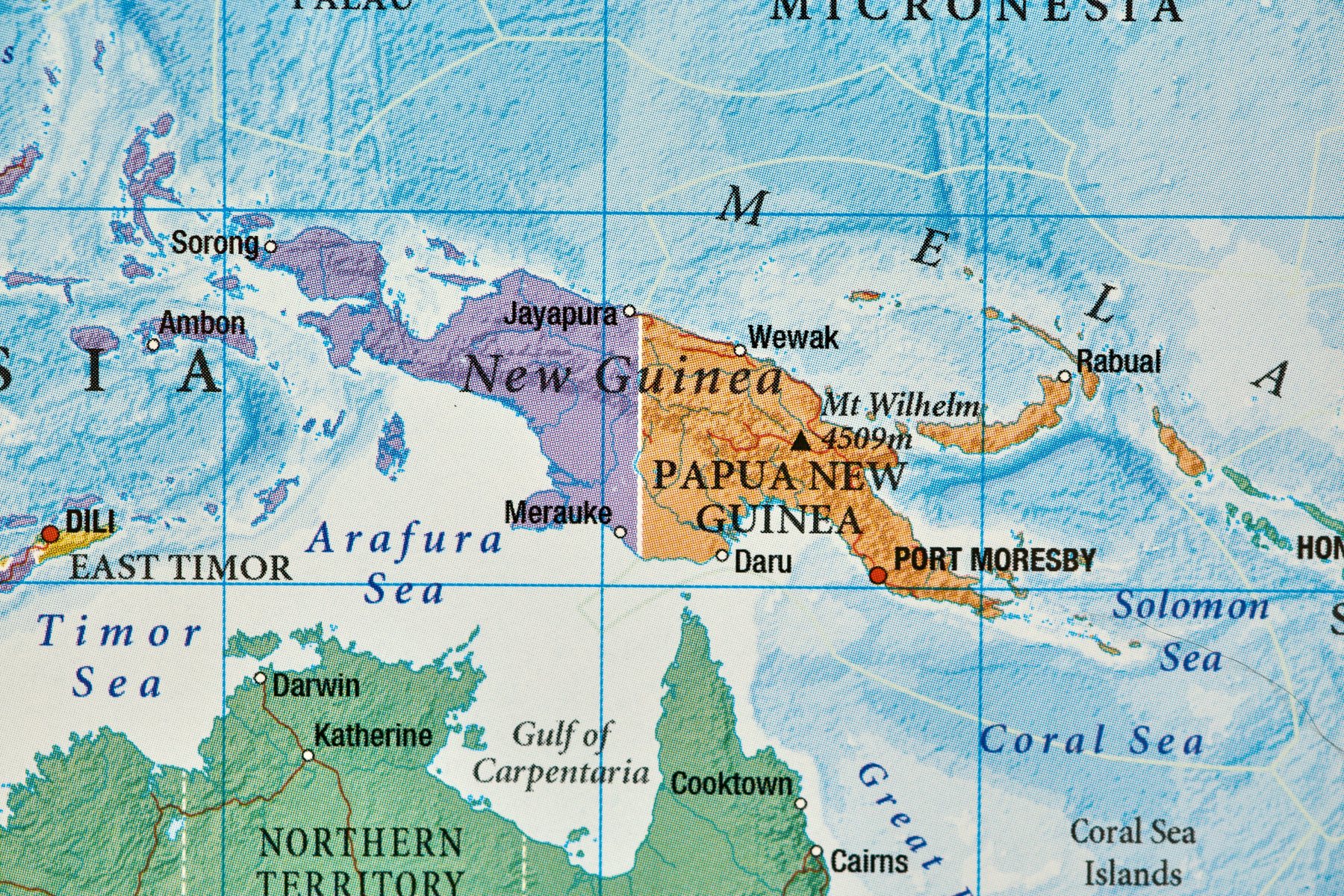
This article provides a deep comparative analysis between Indonesia’s West Papua region and the independent state of Papua New Guinea. They share the world’s second-largest island. They also have a common Melanesian heritage and incredible biodiversity. However, these two entities represent fundamentally different worlds. Examining the Difference Between West Papua and Papua New Guinea reveals deep-seated distinctions. These differences stem from their unique political statuses. These statuses are a result of different colonial legacies and post-colonial paths.
The article’s core argument is that colonial history drives nearly every Difference Between West Papua and Papua New Guinea. West Papua became part of Indonesia after its independence declaration. Indonesia’s territory at independence included former Dutch colonies from Aceh to West Papua. However, the Dutch did not easily release West Papua. They refused to include it in the 1949 Round Table Conference transfer. The Dutch saw economic potential and geopolitical strategy in the region. This claim sparked a prolonged dispute between Indonesia and the Netherlands. The United Nations eventually became involved. The 1962 New York Agreement and the 1969 Act of Free Choice facilitated West Papua’s integration into Indonesia.
In contrast, Papua New Guinea gained independence from Australia in 1975. It faced its own governance and development challenges. Yet, independence allowed it to form a unique national identity. It developed an independent political system and a sovereign foreign policy. This divergence highlights a key Difference Between West Papua and Papua New Guinea.
These distinctions appear in every aspect of life. Politically, West Papua operates under Indonesia’s special autonomy framework. Papua New Guinea functions as a parliamentary monarchy within the Commonwealth. Economically, both rely heavily on extractive industries. But very different state structures manage the revenue. Culturally, official languages and national sports reflect their histories. West Papua has Bahasa Indonesia and soccer. Papua New Guinea has Tok Pisin, English, and rugby. Human development indicators also show a clear Difference Between West Papua and Papua New Guinea.
See also: Fun Facts About the Second Largest Island in the World
The following summary table provides a clear overview. It maps out the most critical distinctions explored in this article.
| Indicator | West Papua (Indonesia) | Papua New Guinea |
| Political Status | Six integrated provinces of Indonesia with Special Autonomy status. | Independent sovereign state; a constitutional monarchy in the Commonwealth. |
| Main Colonial Power | The Netherlands (as part of the Dutch East Indies). | Germany (north), Britain (south), then Australia (mandate). |
| Path to Current Status | 1962 New York Agreement and 1969 Act of Free Choice. | Full, internationally recognized independence from Australia on September 16, 1975. |
| Population (Est.) | Around 5.6 million people (mid-2022). | Around 11.8 million (official) to 17 million people (UN 2022 est.). |
| Total Land Area | Approximately 420,540 km². | Approximately 462,840 km². |
| Official Language(s) | Bahasa Indonesia. | English, Tok Pisin, Hiri Motu, PNG Sign Language. |
| National/Favorite Sport | Soccer. | Rugby League. |
| Currency | Indonesian Rupiah (IDR). | Papua New Guinean Kina (PGK). |
| Human Development Index | 0.655 (average across 6 provinces in 2024). | 0.568 (Medium), Ranked 154 of 193 countries (2022). |
| Main Economic Drivers | Mining (Copper, Gold), Forestry, Palm Oil Plantations. | Mining (Gold, Copper, Nickel), Oil & Gas (LNG), Forestry. |
| Main Tourist Attractions | Raja Ampat (diving), Baliem Valley (culture). | Kokoda Track (history/trekking), Sepik River (culture), Cultural Festivals. |
I. A Land Divided: Geographical and Ecological Context
The island of New Guinea is a land of incredible natural beauty. It holds global ecological significance. This island sets the stage for two very different political entities. This section establishes the shared geographical and environmental context. This context makes the political and social differences even more striking.
1.1. A Tale of Two Halves: Topography, Borders, and Area
The dividing line between Indonesia’s West Papua and Papua New Guinea is a product of colonial map-making. It largely ignored ethnic and geographical realities on the ground. The border mainly follows the 141° East longitude line. It is a straight line from the north coast to the south. It has one major deviation where it follows the Fly River. This arbitrary line cuts through tribal lands and ecosystems. It creates an international border on a unified island.
Both entities share a magnificent mountain backbone that runs across the island. In West Papua, people know this as the Maoke Mountains. It includes Puncak Jaya (4,884 meters), Oceania’s highest peak. In Papua New Guinea, the range is the Central Range. Its highest peak is Mount Wilhelm (4,509 meters). On both sides lie vast, swampy lowlands and dense, nearly impassable rainforests.
In terms of land area, there is a slight difference. West Papua’s six provinces cover about 420,540 km². This is around 22% of Indonesia’s total land area. The independent nation of Papua New Guinea covers about 462,840 km². This makes it slightly larger geographically than the Indonesian side.
1.2. Archipelago Diversity: Comparing the Islands Within
The archipelagic nature of both entities adds another layer of complexity. Both include hundreds of islands off the main landmass. Each island has unique ecosystems and communities.
On the Indonesian side, West Papua includes globally famous archipelagos. The most significant is the Raja Ampat Archipelago. This area is known as the “Four Kings.” It is a world-class diving destination and a center of marine biodiversity. Other important island groups include the Biak Islands and the Yapen Islands.
As a sovereign nation, Papua New Guinea’s territory includes around 600 offshore islands. These islands form major archipelagos with historical and cultural importance. They include the Bismarck Archipelago and the Trobriand Islands. The autonomous region of Bougainville is another major island group. This scattered geography presents significant challenges for governance and national unity.
1.3. A Global Treasure: Biodiversity, Flora, and Fauna
The island of New Guinea is one of the planet’s ecological jewels. It holds the world’s third-largest tropical rainforest. It covers less than 1% of the Earth’s landmass. Yet, it houses about 5-10% of global biodiversity. Two-thirds of its species are found nowhere else on Earth.
The fauna in both regions belongs to the Australian faunal region. This is biologically distinct from western Indonesia. Iconic species inhabit these forests. They include various birds-of-paradise, unique tree kangaroos, and giant cassowaries. The world’s largest butterfly, the Queen Alexandra’s birdwing, also lives here.
The island’s flora is equally impressive. It has an estimated 15,000 to 25,000 vascular plant species. This includes thousands of rare orchid species. The ecosystems are incredibly diverse. They range from mountain glaciers and alpine tundra to lowland rainforests. Below the sea, the ecological richness continues. Both regions lie within the Coral Triangle. This is the global center of marine biodiversity. This amazing biodiversity is a double-edged sword. It is a priceless global asset. But it also faces intense resource exploitation.
II. Divergent Histories, Contested Futures
This section is the core of the article. It explains how the two halves of the island were set on different paths. It details the colonial division and their contrasting decolonization processes. It also discusses the lasting consequences of these histories.
2.1. Colonial Division: Dutch, German, and British Legacies
The modern history of New Guinea was shaped by competing European powers. In the west, the Dutch formalized their claim in 1898. This was based on the sovereignty of the Sultanate of Tidore. For most of the colonial period, the Dutch presence was minimal.
In the east, the division occurred in 1884. Germany annexed the northeastern part. Britain declared a protectorate over the southeastern part. After World War I, Australia captured the German territory. It then became a League of Nations Mandate under Australian administration. Britain had already transferred its territory to Australia in 1906. Australia administered the Territory of Papua and the Mandate Territory of New Guinea separately until after World War II.
2.2. Post-Colonial Crossroads: Act of Free Choice versus Independence
The paths to their current political status were vastly different. This divergence is the main source of their contemporary distinctions.
West Papua’s Integration into Indonesia:
When Indonesia became independent in 1949, the Netherlands retained West Papua. They argued its Melanesian population was culturally different. During the 1950s, the Dutch began preparing the territory for its own independence. In 1961, West Papuans held a congress. They declared independence and raised the Morning Star flag. Indonesia, claiming all former Dutch territories, launched a military invasion. The conflict became a Cold War issue. The United States pressured the Netherlands to yield. The result was the 1962 New York Agreement. It placed the territory under temporary UN administration before transferring it to Indonesia in 1963. The agreement required an act of self-determination.
This event was the “Act of Free Choice” in 1969. It was a process to determine West Papua’s political status. A consensus-based system selected 1,025 tribal representatives. The United Nations approved this representative voting system. All 1,025 representatives chose to remain part of Indonesia. The UN accepted the result with Resolution 2504. This officially recognized West Papua as part of Indonesia.
Papua New Guinea’s Independence:
In contrast, Papua New Guinea’s path followed a more conventional model. After World War II, Australia unified the two territories. A gradual process of political development followed. It established a House of Assembly in 1964 and self-government in 1973. On September 16, 1975, Papua New Guinea achieved peaceful, internationally recognized independence. It became a constitutional monarchy within the Commonwealth. This history shows a stark Difference Between West Papua and Papua New Guinea.
III. Governance and Political Landscape
This section dissects the machinery of government in both entities. It compares their formal structures and the practical application of democracy. It also looks at the unique legal frameworks defining their political realities.
3.1. Structures of Power: Indonesian Provincial vs. Parliamentary Monarchy
The government structures reflect their fundamentally different political statuses.
West Papua (Indonesia):
The region operates within Indonesia’s unitary state framework. Since 2022, Indonesia divides the region into six provinces. A directly elected Governor leads each province. They also have regional legislative bodies (DPRD). A unique institution, the Papuan People’s Assembly (MRP), also exists. It consists of indigenous, religious, and women’s representatives. The MRP holds specific consultative and legislative powers.
Papua New Guinea:
As a sovereign state, Papua New Guinea is a Commonwealth realm. King Charles III is the head of state. A Governor-General chosen by the Parliament represents him. Its system of government is a parliamentary democracy. The Prime Minister is the head of government. He is the leader of the majority party or coalition. The unicameral National Parliament has 118 members. They are elected for five-year terms.
3.2. Democratic Practices: Electoral Systems and Political Freedoms
West Papua (Indonesia):
The region participates in Indonesia’s national and local elections. Citizens can directly vote for the president, national parliament, governors, and mayors. Indonesia’s election commission has worked to reduce the use of the noken system. It strives for more direct voting to improve election integrity. The noken system is a form of communal voting. A traditional leader casts votes on behalf of their group.
Papua New Guinea:
Elections happen regularly but often face challenges. These include irregularities, logistical hurdles, and violence. The country uses a Limited Preferential Voting (LPV) system. Voters rank their top three candidates. This system encourages moderation and coalition-building. Political parties in PNG are numerous but weak. Politics is marked by unstable coalitions and unstable party loyalties.
IV. Socio-Economic Profile and Human Development
This section presents a data-driven comparison of human conditions. It covers demographics, economic structures, and key welfare indicators. Economic drivers present another clear Difference Between West Papua and Papua New Guinea.
4.1. Demographic Realities and Economic Foundations
Population, Ethnicity, and Migration:
There are striking demographic differences. West Papua’s total population is about 5.6 million people. This population is a mix of indigenous Melanesian Papuans and Indonesian migrants. In many urban areas, migrants are the majority. In contrast, Papua New Guinea’s population is much larger. It is estimated between 11.8 million and 17 million. It is almost entirely Melanesian. The PNG population is also highly rural.
Economic Foundations and Mineral Resources:
The economies in both regions share a similar base. Subsistence agriculture supports the majority of the rural population. The formal economies, however, depend heavily on extractive industries. This includes exports of minerals, gas, and timber.
The island of New Guinea holds some of the world’s largest mineral reserves. In West Papua, the Grasberg mine is one of the largest gold and copper mines globally. In Papua New Guinea, the mining sector is more diversified. It includes the Ok Tedi, Porgera, and Lihir mines. Heavy reliance on these resources makes both economies vulnerable. They are susceptible to global commodity price fluctuations. In terms of currency, West Papua uses the Indonesian Rupiah (IDR). Papua New Guinea has its own currency, the Papua New Guinean Kina (PGK).
The table below summarizes their economic and mineral resource profiles.
| Indicator | West Papua (Indonesia) | Papua New Guinea |
| Main Economic Sectors | Subsistence agriculture, Mining, Forestry, Palm Oil. | Subsistence agriculture, Mining, Oil & Gas, Forestry, Fisheries. |
| Main Mineral Exports | Copper, Gold, Silver, Nickel, Oil, Gas. | Gold, Copper, Silver, Nickel, Cobalt, LNG. |
| Major Mining Operations | Grasberg Mine (Copper, Gold, Silver). | Ok Tedi (Copper, Gold), Porgera (Gold), Lihir (Gold), Ramu (Nickel, Cobalt). |
| Currency | Indonesian Rupiah (IDR). | Papua New Guinean Kina (PGK). |
4.2. Human Capital
The following table compares key demographic and human development data.
| Indicator | West Papua (Indonesia) | Papua New Guinea |
| Population | ~5.6 million (mid-2022). | ~11.8 million (official) – 17 million (UN 2022 est.). |
| Population Density | 14/km². | ~25.5/km². |
| Life Expectancy | ~66.99 years (average in 2024). | ~66.13 years (2023). |
| Infant Mortality Rate | ~37.5 (per 1,000 live births, 2023). | ~32 (per 1,000 live births, 2023). |
| Literacy Rate (%) | ~90.5% (average in 2024). | ~63.4% (2023 report). |
| Human Development Index | 0.655 (average in 2024). | 0.568, Ranked 154/193 (2022). |
V. Cultural Fabric and Global Appeal
This section explores cultural expression and tourism. It highlights how different political histories have shaped their recreational and international images. These areas reveal a subtle but important Difference Between West Papua and Papua New Guinea.
5.1. The Linguistic Landscape
New Guinea is the most linguistically diverse place on Earth. Papua New Guinea has over 840 distinct languages. West Papua has over 250 languages. The most significant linguistic Difference Between West Papua and Papua New Guinea lies in their official languages.
West Papua: The sole official language is Bahasa Indonesia. It serves as the lingua franca across the region. The use of Indonesian reinforces West Papua’s integration into the nation.
Papua New Guinea: It has four official languages. English is used in government and business. Tok Pisin, an English-based creole, is the most widely spoken lingua franca. Hiri Motu is used in the southern region. PNG Sign Language is also officially recognized. The use of Tok Pisin reflects the creation of a new, independent national identity.
5.2. A Sporting Divide: Rugby League, Soccer, and National Identity
The choice of favorite sports clearly shows their colonial heritage.
Papua New Guinea: Rugby league is the undisputed national sport. It is a direct legacy of Australian influence. The sport is a major source of national pride and identity. Their national team, the Kumuls, is highly revered.
West Papua: As part of Indonesia, the most popular sport is soccer. This reflects the broader national sporting culture of Indonesia. Clubs like Persipura Jayapura have achieved significant success. They are a source of great regional pride.
5.3. Tourism: Marketing Paradise and Adventure
The nature of tourism in each region reflects its stability and accessibility.
West Papua’s Gems:
Raja Ampat: This is a major international attraction. It is famous as one of the world’s best diving destinations. Tourism here often operates in a relatively isolated bubble.
Baliem Valley: This is a key destination for cultural tourism. It offers trekking and interaction with highland tribes. However, tourism here is more affected by the security situation.
Papua New Guinea’s Icons:
Kokoda Track: This is a world-famous 96km trekking route. It follows the path of fierce World War II battles. It is a major pilgrimage site, especially for Australian tourists.
Sepik River: This offers cultural cruises by canoe or riverboat. Visitors see remote villages famous for their art and spirit houses.
Cultural Festivals: Major events like the Goroka Show attract international tourists. They come to witness spectacular tribal cultural performances (singsings).
See also: West Papua: The Ultimate Guide