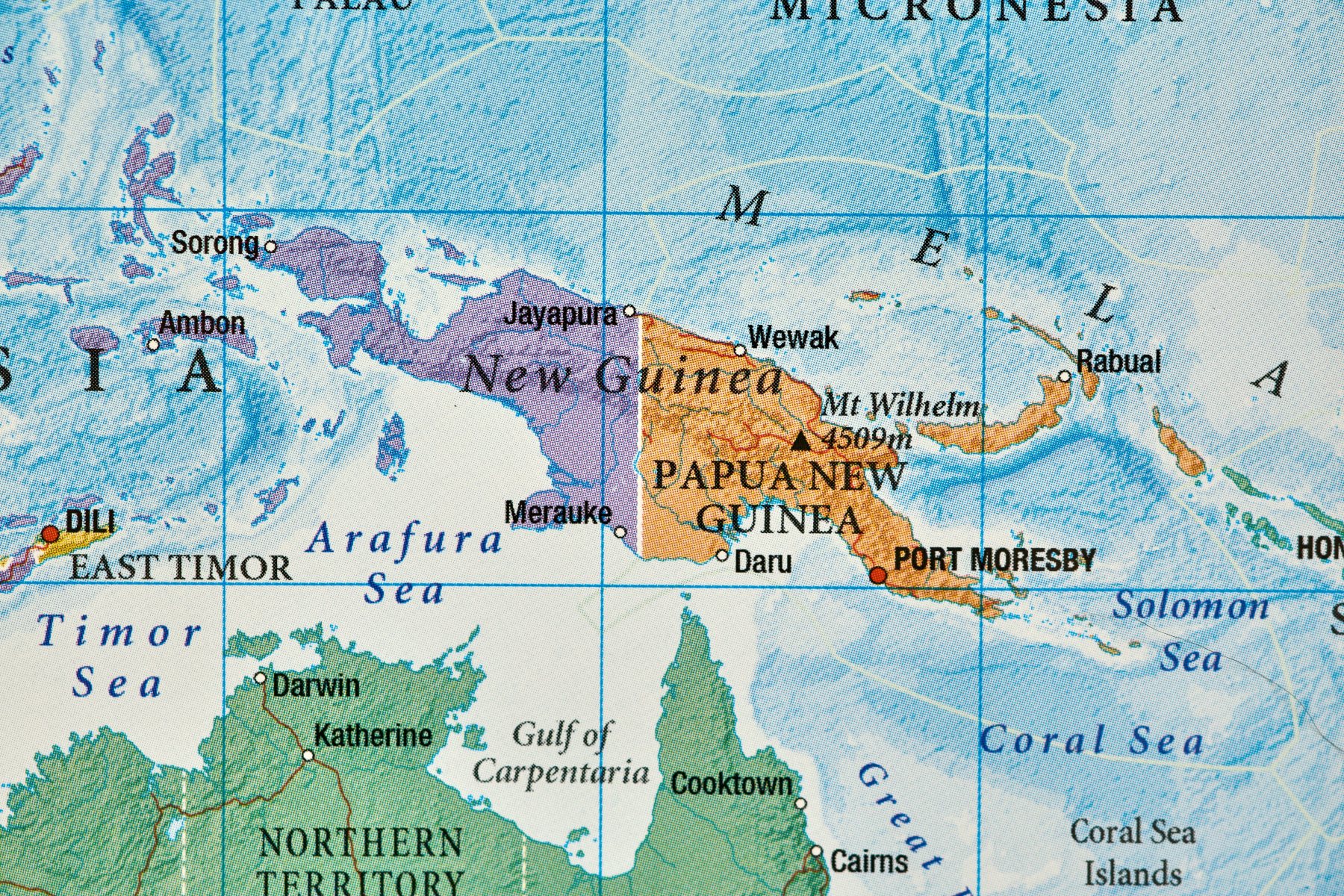
Papua Island, the world’s second-largest tropical landmass, presents a profound anomaly and wonder in the global linguistic landscape. With over 1,000 languages spoken across its rugged terrain, the island houses about one-sixth of the world’s total languages, establishing itself as the planet’s most densely linguistically diverse region. This comprehensive analysis argues that Papua’s status as a linguistic “hotspot” is not accidental; instead, it results directly from the unique convergence of an unparalleled depth of human occupation time—over 50,000 years—and an extremely fragmented geography. This combination fostered profound isolation, allowing hundreds of distinct languages to evolve as crucial markers of tribal identity. Understanding the story of language on Papua Island reveals an essential chapter in human cultural history.
Cradle of Diversity: Geography and Political Landscape
Papua Island’s physical environment is not merely a backdrop for its linguistic drama; it actively drives the diversification. The island’s extreme topography created the necessary conditions for human populations to remain isolated for millennia, setting the stage for intensive linguistic divergence and differentiation.
A World Apart: Topography Driving Isolation
The island’s highly fragmented landscape is the most critical factor shaping this isolation. Dominant features actively separate populations:
- Central Highlands: A massive mountain range forms the island’s spine, creating a formidable barrier to travel. Peaks like Puncak Jaya rise over 5,000 meters above sea level, effectively shattering the landmass into isolated valleys.
- Extensive Lowlands and Swamps: Vast, difficult-to-cross swampy lowlands exist in the southern and northern parts, particularly around major river basins like the Digul and Mamberamo. This terrain further reinforces population segmentation.
- Dense Tropical Rainforest: Over 70% of the island’s area is covered by dense tropical rainforest. Historically, this forest limited large-scale agriculture and population movement, fostering scattered, self-sufficient small communities.
One Island, Two Nations: The Political Divide
Politically, the landmass divides into two national jurisdictions by a largely straight border.
- West Papua (Indonesia): This western half has undergone significant administrative changes, now consisting of six provinces: Papua, West Papua, Central Papua, Highland Papua, South Papua, and Southwest Papua. A strong national identity project centers on Bahasa Indonesia.
- Papua New Guinea (PNG): The eastern half became an independent nation in 1975. PNG’s post-colonial nation-building process involves different lingua francas: Tok Pisin and English.
The political border—an artificial layer created by colonial history—splits many language families, such as the massive Trans-New Guinea phylum. Consequently, historically related linguistic communities are subject to two contrasting sets of modernization pressures.
| Feature | West Papua (Indonesia) | Papua New Guinea (PNG) |
| Political Status | Provinces of the Republic of Indonesia | Independent nation (Commonwealth member) |
| Official Languages | Bahasa Indonesia | English, Tok Pisin, Hiri Motu, PNG Sign Language |
| Primary Lingua Franca | Papuan Malay (a variation of Bahasa Indonesia) | Tok Pisin |
| Estimated Indigenous Languages | >270 languages | ~840 languages |
The Echo of Deep Time: History of Settlement
To understand the roots of Papua’s extreme linguistic diversity, we must delve into deep time. The island possesses one of the longest modern human settlement histories outside of Africa. This extraordinary temporal depth is the single most important factor enabling such massive linguistic diversification.
First Footprints: Early Human Migration
Genetic and archaeological evidence confirms that the first modern humans arrived in Papua at least 50,000 years ago, with some estimates reaching 65,000 to 70,000 years ago. During this Pleistocene period, lower sea levels joined New Guinea and Australia into one giant landmass called Sahul Continent. These initial migrants were master mariners who navigated open ocean stretches to reach this new continent. They became the ancestors of the current speakers of the vast majority of “Papuan” (non-Austronesian) languages. For over 45,000 years, they spread, adapted, and diversified across the challenging Sahul landscape with minimal interruption.
A Tale of Two Phylums: Austronesian Arrival
The demographic and linguistic landscape dramatically changed with a much more recent second migration wave. Around 3,500 years ago, Austronesian language speakers arrived on the coasts and surrounding islands of New Guinea. These migrants, associated with the Lapita culture, brought distinct technologies and culture, including pottery and new farming practices.
The Austronesian speakers mostly settled in coastal areas and offshore islands, but they did not displace the established Papuan populations in the interior and highlands. This established a fundamental linguistic and cultural division persisting today: Papuan languages dominate the interior, while Austronesian languages occur along many coastal strips and surrounding islands. The current language map of Papua is a layered history: Papuan languages represent the deep, original layer fragmented by time and geography, and Austronesian languages represent the newer, thinner coastal layer.
The Engine of Diversification
Why did so many distinct languages evolve and survive on Papua? The answer lies in a powerful feedback loop between extreme geographical isolation and the socio-cultural function of language as an identity marker.
Isolation as an Incubator
The Papuan terrain of steep mountains, deep valleys, and impassable swamps effectively created thousands of isolated pockets—”islands within the island”. In these isolated communities, language evolved independently. Over millennia, natural processes of linguistic change, known as linguistic drift (sound shifts, grammatical changes, and vocabulary replacement), caused formerly related dialects to become mutually unintelligible languages. The geography did not just limit interaction; it fostered unique local adaptation. Remote communities, shielded from external influence, retained their unique customs, languages, and practices over generations.
Language as Identity: “We Are Our Language”
In Papuan tribal societies, language is more than a communication tool; it stands as the primary, powerful symbol of clan, tribal, and ethnic identity. Speaking a particular language signals membership in a specific group sharing common ancestors, territory, and traditions.
Consequently, linguistic diversity is not merely a passive result of isolation. Groups often actively maintain it, and sometimes deliberately create it, to reinforce social boundaries and differentiate themselves from neighbors, who might be rivals or enemies. In some cases, communities intentionally modify their language to distinguish themselves. Other social factors, like inter-group warfare or the practice of word taboos (e.g., changing a word if it sounds similar to a deceased person’s name), accelerate linguistic change and differentiation.
This powerful feedback loop—where geographical isolation allows linguistic drift, which then becomes a symbol for active social differentiation—is the hyper-diversity generating engine of language on Papua Island. The deep time available further amplifies the effects.
The Structural Mosaic: Lingua Franca
The linguistic landscape features a staggering number of languages, complex family groupings, and unique typological features.
Unprecedented Number of Languages
The scale of linguistic diversity is astounding; the entire island hosts over 1,000 languages.
- PNG: Consistently recognized as the most linguistically diverse country on Earth, with 840 living languages listed.
- West Papua (Indonesia): The western side exhibits incredible diversity, home to over 270 languages.
The majority of these languages have very small speech communities, often just a few hundred or thousand speakers. This small size makes them highly vulnerable to language shift and extinction.
The Papuan Enigma versus Austronesian Families
The term “Papuan languages” is a geographical label, not a genetic classification. It serves as an umbrella term for all non-Austronesian languages in the region, which do not descend from a single proto-language. These languages may belong to as many as 60 different language families, plus many isolates. The largest proposed grouping is the Trans-New Guinea phylum. While varied, many Papuan languages share structural tendencies that differentiate them from Austronesian languages.
| Typological Feature | Typical Papuan (e.g., Trans-New Guinea) | Typical Austronesian |
| Basic Word Order | Subject-Object-Verb (SOV) | Subject-Verb-Object (SVO) |
| Verb Complexity | Highly complex, agglutinative; verbs marked for subject & object | Simpler, less affixation |
| Grammatical Relations Marking | Case marking, verbal agreement | Prepositions, word order |
Bridging the Divide: The Role of Lingua Franca
This highly fragmented landscape necessitated the adoption or creation of unifying languages for regional and national communication. This led to widespread, obligatory multilingualism: an individual’s linguistic repertoire typically includes a local language (for identity), a regional lingua franca (for trade), and potentially a national/global language (for official affairs).
- Tok Pisin (PNG): A creole language based on English, Tok Pisin is an official language and the most important lingua franca. It evolved in 19th-century plantations and incorporates vocabulary from English, German, and local languages.
- Papuan Malay (West Papua): A distinct Malay/Indonesian dialect has served as the lingua franca for centuries. This language has unique phonological and morphological features influenced by local languages, such as using tra for “no”. Papuan Malay is the primary means of inter-ethnic communication and has become a marker of its own regional identity.
The Modern Test: Threats to Language on Papua Island
Papua’s ancient linguistic heritage now faces an existential threat from modern forces of homogenization, globalization, and socio-economic change. This constitutes a fundamental reversal of the socio-ecological pressures that shaped the island for 50,000 years. The linguistic ecosystem that took 50 millennia to build is being dismantled within a few generations.
The Double-Edged Sword of National Languages
Bahasa Indonesia and English, as the official languages of state, education, commerce, and media, carry immense prestige and practical value. While these languages play a positive role by providing access to broader communication and economic opportunities, their dominance creates intense pressure for language shift. Younger generations increasingly choose the national language over their ancestral language, often deeming it less useful for modern life. This phenomenon effectively severs the chain of intergenerational transmission, the primary mechanism for a language’s survival.
The Silent Fade: Endangerment and Extinction
Papua is a biodiversity hotspot, and it is also an endangerment hotspot. Most of its languages face threat. UNESCO has labeled all Papuan languages as ‘threatened’.
- Scale of the Crisis: In PNG, 314 languages are classified as endangered. In West Papua, 42 languages are categorized as highly endangered.
- Drivers of Extinction:
- National Language Dominance: This remains the leading factor.
- Urbanization and Mobility: Moving to cities for work or school necessitates using the lingua franca, reducing the domain of use for the mother tongue.
- Inter-Ethnic Marriage: Children in mixed-language families often grow up speaking only the lingua franca.
- Transmigration (West Papua): In West Papua, transmigration policies have made indigenous Papuans a minority in their own land, contributing significantly to local language endangerment.
The crisis is visible across the island. The language Air Matoa in West Papua became extinct after 2010 when its last speaker passed away.
| Language | Location | Estimated Speakers | Vitality Status (EGIDS/UNESCO) | Major Threat |
| Dani (Baliem/Hubula) | Highland Papua | >100,000 | 6a (Vigorous) – Stable but vulnerable | Pressure from Bahasa Indonesia in urban centers |
| Moi | Southwest Papua | ~4,000 | 7 (Shifting) – Threatened | Urbanization, inter-ethnic marriage, Papuan Malay dominance |
| Tobati | Papua (Jayapura Bay) | <50 (elderly speakers) | 8b (Nearly Extinct) – Highly Endangered | Dominance of Papuan Malay/Indonesian; broken intergenerational transmission |
The documentation, revitalization, and preservation of Papua’s linguistic richness are not merely regional concerns; they represent a global urgency to safeguard one of humanity’s most precious cultural heritage treasures. The world must act to preserve the unique language on Papua Island.
See also: West Papua: The Ultimate Guide to Culture, Capital, and Nature