The dense forests of Papua shelter some of the world’s most extraordinary biological treasures. Hidden within these lush landscapes, researchers frequently encounter the Biggest Banana Tree, scientifically known as Musa ingens. This botanical marvel remains an exclusive resident of this island, captivating anyone who witnesses its massive proportions.
The Massive Scale of the West Papua Banana
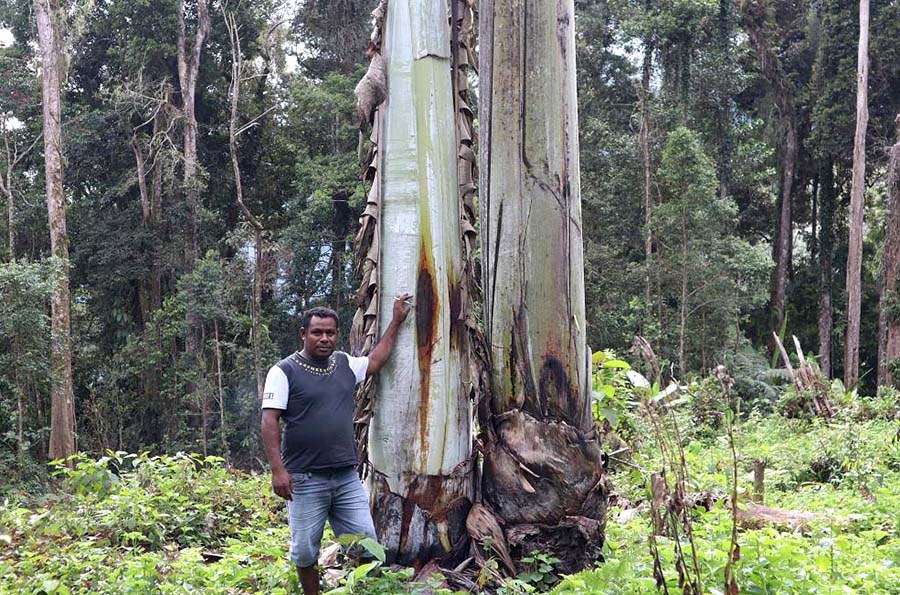
Locals often compare this plant to a coconut tree because of its staggering height. The trunk’s circumference easily exceeds the arm span of an adult, making it a true titan of the forest. The West Papua Banana serves various purposes for the indigenous people, who have utilized its stems, leaves, and fruit for generations.
A Legacy of Botanical Discovery
Norman Willison Simmonds, an English botanist, traveled across the Asia Pacific from 1954 to 1955 to collect rare plant specimens. As a leading expert, his books Bananas and The Evolution of Bananas still serve as primary references for plant breeding. During his expedition, he officially recorded the Biggest Banana Tree after finding specimens in the Aiyura and Morobe districts.
Record-Breaking Dimensions of the World’s Largest Herb
In terms of pure scale, no other plant challenges this giant. In the wild, the Biggest Banana Tree reaches heights of up to 25 meters. Its massive leaves span six meters in length, while a single bunch can hold 300 fruits weighing up to 60 kg. Because the fruit contains many seeds, residents rarely eat it, preferring to use the plant for medicinal purposes instead.
Traditional Uses of the West Papua Banana
Ayub Yekwam, Head of Banfot Village, explains that the West Papua Banana provides essential materials for daily life. Residents transform the giant leaves into makeshift roofs, seating mats, and food coverings. In the local dialect, people refer to this plant as ndowin or apit sepoh. They often use the sturdy midribs to store garden produce or game from hunts.
Habitat and Environmental Needs
This giant thrives in the highlands, specifically at altitudes between 1,200 and 2,000 meters above sea level. The Biggest Banana Tree requires the cool, foggy environment of the rainforest to grow properly. It stands tall among other trees, competing fiercely for sunlight in the canopy.
Future Opportunities and Conservation
Experts like Jeff Daniells believe the Biggest Banana Tree holds significant genetic potential. While it cannot survive in hot lowlands, scientists might one day use its genes to develop cold-resistant crops through genetic engineering. Currently, the distribution of the West Papua Banana spans across Manokwari, Kaimana, and the Arfak Mountains. Because this species is difficult to cultivate outside its habitat, we must preserve Papua’s primary forests to ensure its survival.