The digital world offers a staggering amount of data when users search for rare flora on major search engines. However, much of the viral information regarding the Papua Black Orchid lacks rigorous scientific verification. Most online sources fail to provide precise geographic coordinates, specific altitudes, or a verified scientific identity. These articles often claim that the orchid is an endangered species residing exclusively in deep interior forests, making cultivation outside its natural habitat nearly impossible. When you combine this air of mystery with a rumored price tag of 100 million rupiah, it is easy to see why this plant captivates the public imagination.
Debunking Common Misidentifications
Many trending articles feature a specific image that they incorrectly label as a native black orchid from Papua. These photos typically display a flower with a white labellum, dense pink spots along the edges, and a yellow callus marked with black center streaks. In reality, these images usually depict the Kalimantan black orchid (Coelogyne pandurata) or the famous Cymbidium Kiwi Midnight ‘Geyserland’.
Botanists distinguish the Cymbidium Kiwi Midnight ‘Geyserland’ as a hybrid or “cruciferous” orchid that dominated the market between 2001 and 2015. Andy Easton, a renowned cultivation expert from the United States, created this hybrid by crossing Cymbidium Janet Holland with Cymbidium Khairpour. While beautiful, this American creation does not qualify as the true Papua Black Orchid because it shares no genetic lineage with the natural species of New Guinea.
Scientific Profile of the Rare Dark Flora
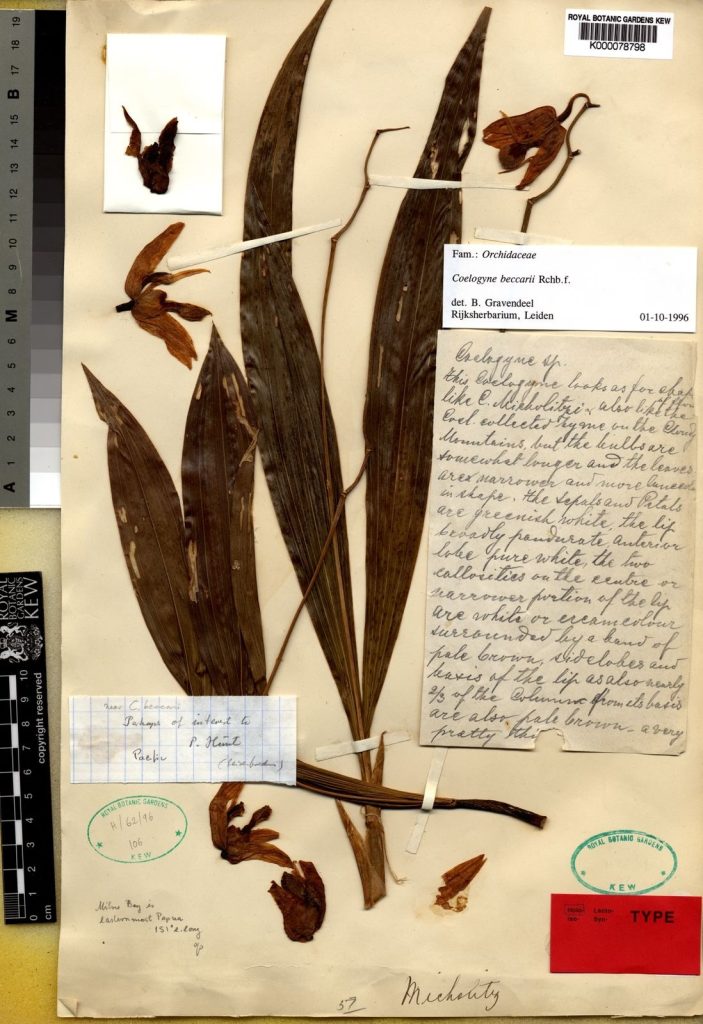
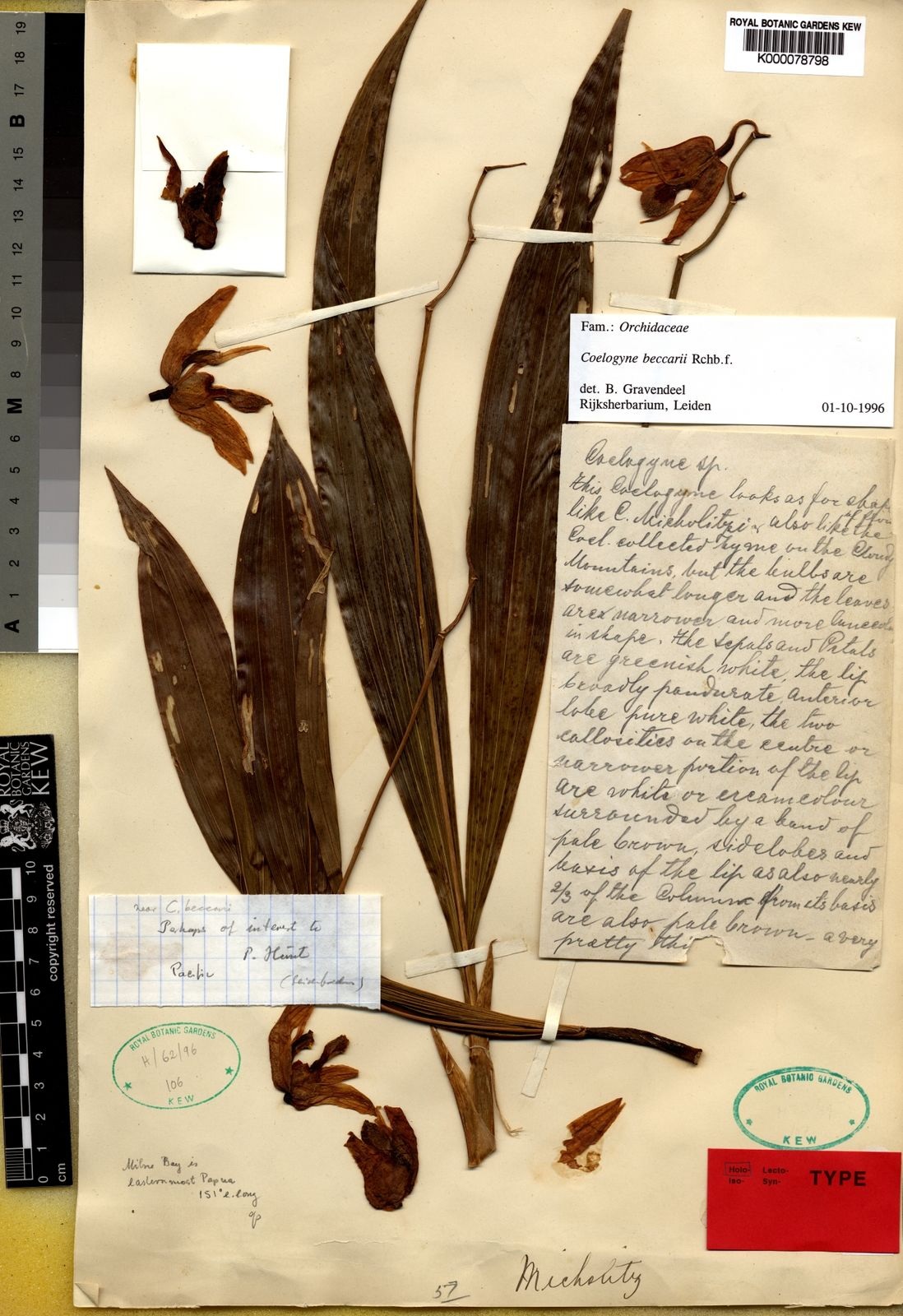
Indigenous communities in West Papua often harvest wild orchids from the forest and refer to them locally as the Papua Black Orchid. Scientific investigations into these local specimens frequently point toward Coelogyne beccarii Rchb.f. as the true identity. While this species carries the local mantle of the “black orchid,” the international botanical community still recognizes a distinction between local nicknames and formal classifications.
According to botanical records, Coelogyne beccarii functions as an epiphytic or lithophytic plant. It thrives in the primary forests of West Papua and Papua New Guinea, typically at altitudes ranging from 200 to 300 meters above sea level, though some variations appear in higher montane regions.
Botanical Characteristics of Coelogyne beccarii Rchb.f.
To identify the authentic Papua Black Orchid (specifically the beccarii species), one must look at the specific morphological traits:
- Rhizomes and Roots: The plant features a creeping root system that can extend up to 50 centimeters along tree bark or rocks.
- Pseudobulbs and Stems: The stems exhibit a dark, almost black coloration and a texture similar to rattan. These structures can reach a length of 100 centimeters.
- Foliage: The plant produces single, elongated leaves that grow up to 25 cm in length, often maintaining a deep, dark green or blackish hue.
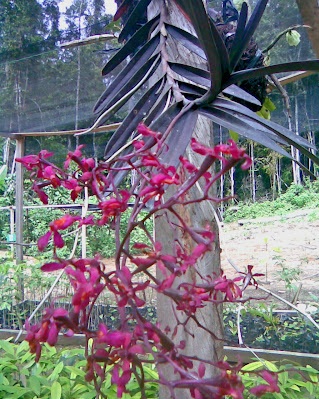
- The Inflorescence: Unlike the hybrids, the flowers of this Papua Black Orchid relative appear red and feel stiff, almost like plastic. The slightly dark, branching flower stalks grow to approximately 55 cm.
- Seed Development: The seeds form within the flower stalks. As they mature, the stalks enlarge and turn a deep black.
- Distinctive Feature: Observers note that the plant achieves a “total black” appearance when the flower stalk enlarges into a shape resembling a guava fruit.